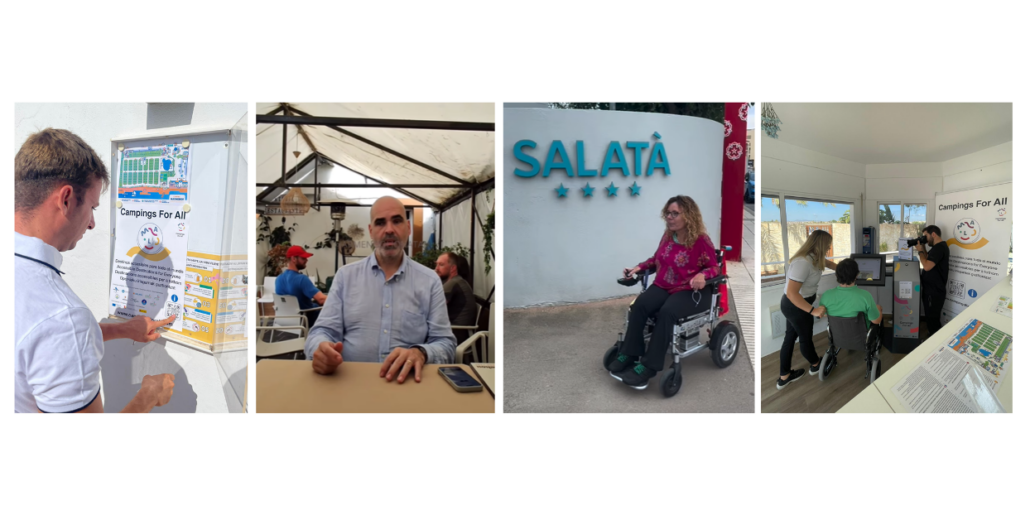
One hundred families and professionals who care for people with functional diversity will enjoy free stays at campsites thanks to the Campings For All project.
People with functional diversity are discovering the world of camping as a welcoming and family-friendly destination that provides them with a safe environment.
The initiative aims to continue its growth in 2026, following a highly positive collaboration among the 10 participating campsites.
Thanks to the European grant ‘Campings For All’ (CFA), the following campsites are now inclusive tourist destinations, transforming them into a safe space for people with disabilities: La Ballena Alegre, Camping Salatà, Camping Son Bou, Camping La Regalina, Camping Don Cactus, Camping El Astral, Camping Caravaning Mar Menor, Gran Camping Zarautz, Camping Ribamar, and Camping Lago Resort.
The project is part of the ‘Experiencias Turismo España’ program and is being carried out through the impetus and funding of the European Union, NextGenerationEU, the Ministry of Industry and Tourism, and the Recovery, Transformation and Resilience Plan.
Since the project began, the campsites have worked to adapt to the needs of people with functional diversity. They now feature accessible services and informational campaign materials, as well as tools and resources to make the campsites a friendly space for everyone. As part of this commitment, and in collaboration with various associations, they have begun to offer free stays to the caregivers of people with diversity. Given the family nature of campsites, this context is considered ideal. This is an initiative that aims to continue its growth towards 2026, seeking to include this collective—often overlooked by the administration—that carries a great physical and emotional burden and has few opportunities for rest or respite.
Experience Lived First-Hand
During the project deployment visits made by the Campings For All team to the different campsites to distribute materials, the team was also able to hear first-hand the experiences and testimonials of people with diversity.
With this informative and outreach goal, two CFA influencer advocates, Jonatan Armengol and Montse Font, visited some campsites for the first time to live and share the experience personally. Jonatan, who has a visual impairment, visited Camping El Astral and La Regalina, while Montse, who has reduced mobility, stayed at Campings Ribamar, Salatà, and Ballena Alegre.
Montse Font, user with reduced mobility:
“For me, a campsite was previously a hostile environment that I couldn’t access. Discovering the world of camping is something I’ve loved, even more than a hotel, because I see that the treatment is much more personal, both with the staff and among the users. I have discovered a reality that I thought was inaccessible but is, and I have enjoyed it immensely. We take it for granted that campsites are not adapted, but the reality is that they are.”
Jonatan Armengou, user with visual impairment:
“My family had never considered campsites, and I had always thought it was too complex a space for a blind person to enjoy, and it has been a total surprise. A place with people who have spectacular social awareness, with well-organized and designed spaces. Since we participated in this project, it has become a definite option for family enjoyment: it has stolen our hearts, and we will repeat the experience.”
Growing Interest in Accessible Tourism
Their stay, beyond allowing an assessment of the suitability of the accessibility improvements made, has also been a way to gauge the impact the project is having on people with functional or visual diversity. The campaign is already generating interest, and the influencers have begun receiving messages from people interested in enjoying this accessible and inclusive form of tourism.
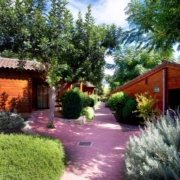
In this regard, it is worth noting that some campsites are also working to offer adapted and more accessible activities. The campsites adhering to the project have improved the adaptation of their facilities and continue to work in this direction. Some of the actions include the installation of adapted bungalows, plots, games, ramps, hydraulic chairs, and accessible bathrooms, among others.
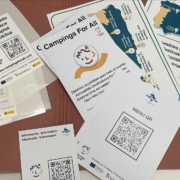
Furthermore, the campsites now have informational totems through which visitors can access the Campings For All website. These devices are adapted to the height of people in wheelchairs and include information in Braille and a QR code for mobile access. Similarly, three posters, a roll-up banner, and an informational leaflet in Braille have been distributed, along with two types of stickers: a generic one that, under the slogan “We are members,” informs of the campsite’s adherence to the CFA project; and a specific one that allows campsites to indicate which bungalows, bathrooms, pools, etc., are an “Adapted Space.”
All these materials have been designed with an eye on inclusive tourism, including for people with visual difficulties. To achieve this, the font size of the materials has been adapted, an adequate color contrast has been sought, and a QR code has been included on all materials that leads to a website adapted for blind people. Specifically, an adaptation of the restaurant menus was also completed in September.
Aware of the importance of communication, the CFA team, which has been supported and advised by a company specialized in functional diversity, has also created a protocol to follow when making publications on social media, helping the campsites advance toward more inclusive communication in this area.
In addition to social benefits, the project also has environmental advantages, as it includes the protection of the natural territory where the campsites are located, which favors landscape integration and prevents urban degradation. The campsites facilitate contact with nature, improving the health and well-being of users. Accessibility for people with disabilities is also improved, promoting social justice. At a tourism level, the project boosts the quality of the offering, fosters new complementary services, and helps reinforce Spain’s tourism brand.
For more information, please visit the website: www.campingsforall.com